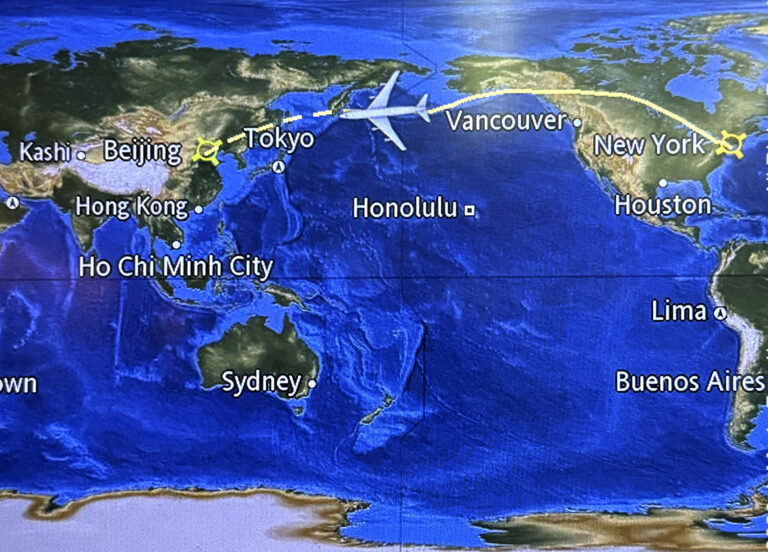
The adventure begins with the 2 a.m. departure from New York where the journey immediately dissolves into a 20-hour odyssey across fifteen time zones. To travel from the Atlantic coast to the deep interior of Asia is to submit to a specific kind of temporal “limbo” — a state where the body is moving at 500 miles per hour while the mind remains anchored in the departure lounge.
The most profound moment of this transition occurs six miles above the earth. As the aircraft pushes eastward, chasing the sun, the transition from night to day becomes a visceral experience. Looking out the window as we approach the Asian landmass, the horizon begins to bleed a bruised purple, then a sharp, neon orange that seems to ignite the top of the atmosphere. Watching the sunrise from 35,000 feet is a reminder of the scale of this undertaking. Below us, the vastness of Siberia and Northern China begins to reveal itself, a landscape of jagged ridges and frozen plains that serves as a silent prelude to the Tibetan Plateau. It is here, in the thin air of the stratosphere, that the reality of the distance truly settles in. We are no longer in the West, the light itself feels different.
Landing at Beijing Capital International Airport (PEK) is a sensory and cognitive shock. This is my first trip to China, and despite the presence of English subtitles on the overhead signage, the experience is one of profound semiotic confusion. The airport is a gargantuan feat of architecture — all soaring glass and red steel — but it is the weight of the Chinese characters that leaves the deepest impression. Even without being able to read them, the graphic imagery of the Hanzi characters has a visual mass, a structural authority that makes the English translations feel like an afterthought. Navigating this labyrinth requires a shift in consciousness; you learn to read the flow of the crowds and the rhythm of the security gates rather than the words themselves. The scale of the terminal is a physical manifestation of China’s modern ambition, a “hyper-city” contained within a single roof.
The layover in Beijing is not a time for rest, but a high-stakes logistical sprint. In the digital ecosystem of China, being “connected” is not a luxury, it is a requirement for survival. My first mission is the “Great Setup” — acquiring a Chinese SIM card and configuring an eSIM to navigate the unique digital landscape of the mainland. But there is a more analog hurdle to clear — the power bank. In China, aviation security is notoriously strict regarding lithium batteries. Any power bank brought from America that lacks a visible “CCC” (China Compulsory Certificate) rating or clear watt-hour markings is liable to be confiscated at the domestic transfer gate. Finding a CCC-rated power bank in the airport shops becomes a scavenger hunt of necessity — a reminder that in this part of the world, the rules of the road (and the air) are governed by a different set of standards.
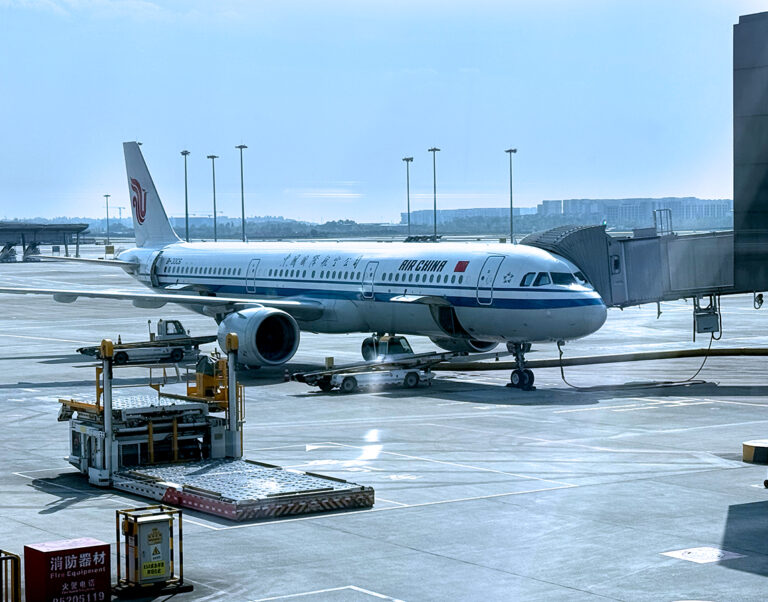
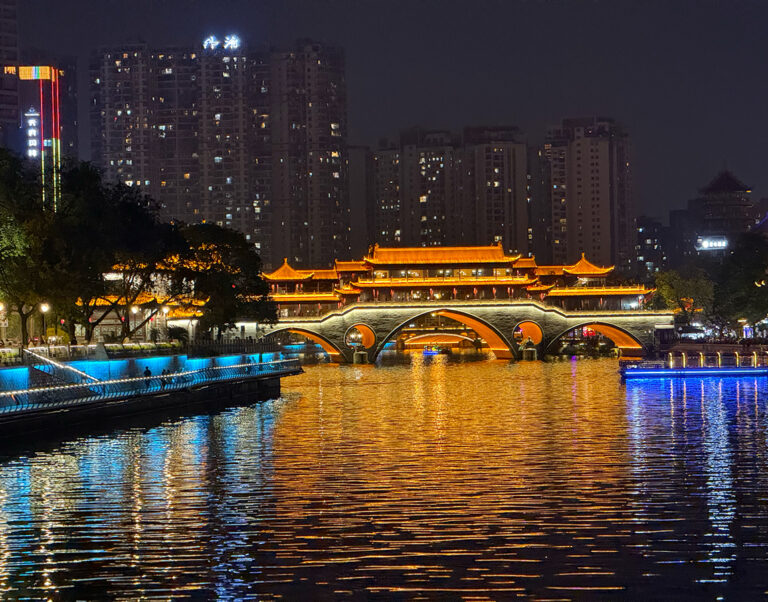
The final logistical hurdle in the capital is the dash to the gate for my connecting flight to Chengdu (CTU). Boarding the flight feels like crossing the final threshold; the polished internationalism of Beijing fades as the cabin fills with the rapid-fire cadence of Sichuanese dialects. As the plane descends through the perennial mist that shrouds the Sichuan Basin, the jagged silhouettes of the Longmen Mountains — the literal gateway to the high plateau — tease their presence through the clouds. Touching down at Shuangliu International Airport, the air is noticeably heavier, carrying the faint, spicy scent of coal smoke and peppercorns. The transition from the sterile cabin to the humid energy of the terminal is a blur of neon and motion. By the time the taxi weaves through the high-rises toward the hotel, the 20-hour odyssey finally catches up. The hum of the city fades behind the heavy curtains of the room, leaving only a few precious hours of stillness before we begin driving tomorrow morning.