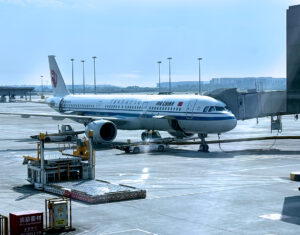
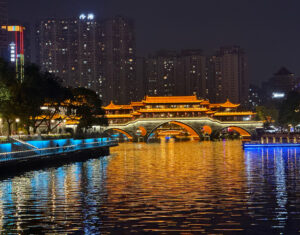
The upcoming expedition is primarily defined by its remote landscapes, but the journey begins and ends in the dense, vertical energy of the Sichuan Basin. We are planning to take a little bit of time to include some “urban exploring,” to see how traditional culture survives and adapts within the rapid-fire modernization of 21st-century China.
The Megacity Grid: Chengdu
Chengdu serves as the primary jumping-off point. As the capital of Sichuan, it is a sprawling metropolis that manages to feel both futuristic and deeply ancient. While it is globally recognized as the gateway to the Giant Panda habitats, the true urban character of the city lies in its architectural and social layers.
The exploration here is defined by contrast. On one block, you might find a high-tech financial hub with gleaming glass facades; turn a corner, and you are in a quiet pocket where the air smells of Sichuan peppercorns and coal fires.
The spatial logic of Chengdu is roughly organized in concentric rings, with inner districts like Qingyang housing historical anchors such as the Wenshu Monastery. In these areas, urban exploration is about finding the tension between preserved spiritual sites and the encroaching skyline. Beyond the main thoroughfares lie the smaller lanes—remnants of an older urban fabric. These alleys are the city’s pulse, where generational tea houses provide a slow-motion counterpoint to the high-speed transit systems overhead.
The Plateau Crossroads: Yushu
Further along the route lies Yushu (known as Jyekundo in Tibetan), situated at an elevation of nearly 3,700 meters. The urban experience here is vastly different from the humid lowland density of Chengdu. Yushu is a city defined by resilience and transformation, having been extensively rebuilt following the 2010 earthquake.
Navigating Yushu is an exercise in cultural geography. It serves as a vital hub for Tibetan trade and language. The “urban” element here is inextricable from the landscape; the city is cradled by mountains, with monasteries like Jyeku Monastery overlooking the modern grid below. Exploration in Yushu involves observing how traditional Tibetan motifs have been integrated into new, earthquake-resistant urban planning, creating a unique “Highland Modernism.”
Logistics of the Unknown: Getting Around
Navigating a major Chinese city for the first time requires a blend of digital tools and analog intuition. When the language barrier is high, the infrastructure becomes the primary guide. The Chengdu Metro serves as the subterranean spine of the city and is the most efficient way to dissect its various districts. The system is clean, fast, and features bilingual signage in Mandarin and English, allowing for “anchor-based exploration.” This involves taking the train to a distant district, exiting at a random station, and walking a wide radius to observe how the neighborhood character shifts away from the city center.
Digital navigation and translation are equally essential in a landscape where standard Western tools are often unreliable. Using China’s mapping apps, like Baidu Maps or Amap, provides the most accurate real-time data for transit and walking paths; even without reading the characters, the visual pathfinding remains intuitive. For communication, maintaining offline translation packs for technical terms or utilizing translation apps via a roaming data plan is the key to interacting with local markets or reading street signs in the older, more traditional districts.