NOTES FROM THE ROAD


NY: New Year’s Eve…


Celebrating the New Year…


31 December 2025: Had time to go get supplies for a nice quiet and calm New Year’s Eve at home by the fire pit. Wishing everyone a fun and adventurous New Year, with many happy trails along the way…


MD to NY: The Last Leg to Home…


Long drive day, but made it…


30 December 2025: Final marathon drive day today — Maryland, Delaware, New Jersey and New York — and I didn’t really stop apart from gas and bathroom breaks. The traffic wasn’t too bad and I was able to make it home to Long Island a little after sunset. It was cold and wintery, but still felt good to be home…


SC to MD: Heading North…


Taking a pause at the Tobacco Farm Life Museum…


29 December 2025: Rainy morning in Florence, SC, but I made a short stop at the Buc-ee’s anyway. Then as I continued north into North Carolina the rain let up a bit, though it was still overcast and the skies were threatening. It was getting colder, too. I made a short stop to stretch my legs at the Tobacco Farm Life museum in Kenly, NC. The museum was closed but the site had some small walking trails between the old farm buildings so I was able to at least take a walk around and see the structures and some old tools that were on display outside. Then I got back on the road and made it to Ashland for dinner, where a lot of places were closed, but I found a small farm-to-table cafe that was open, and took a little walk around the main street by the train tracks before the evening’s final drive. I pushed on into Maryland before stopping, so I am well-positioned to make it home tomorrow night…


GA to SC: Cumberland Island…


Stepping back into history…


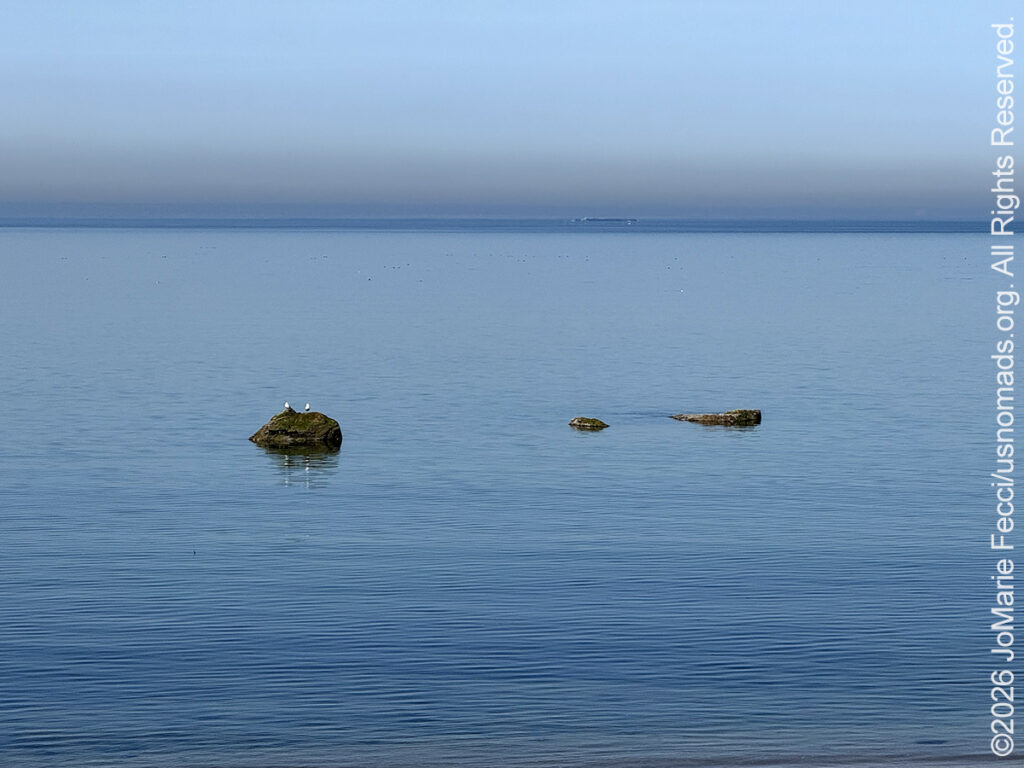
28 December 2025: I was up early to be “on-time” for the ferry that would take me to Cumberland Island this morning. The boat was full, and I was lucky to have gotten a seat inside the cabin, because outside it was wet and cold as we sailed through the thick morning fog to the famous sea island. At the dock we were unloaded and left for the day to go exploring, with the boat coming back later in the afternoon to pick us up. The crowd slowly dispersed in different directions according to their interests and I hung back to let them go so that I would have a more “empty” landscape to photograph. My first stop was the Dungeness mansion ruins, which were truly impressive upon approach, maybe even more eerie thanks to the low clouds and dreary skies. I soon found a few of the wild horses and spent a little time photographing them before continuing my exploration along the sand dunes and then around the island to the marsh side where there was a boardwalk and then a trail that went right along the edge of the water. It was a beautiful environment and fun to explore such a pristine example of sea island ecosystems. And the ruins were quite impressive too. By late afternoon the sun had come out and it was transformed into a completely different space. I finished up my exploring and returned to the dock in time for the ferry and this time I sat outside in the sun as we sailed back to St. Mary’s along the edges of the wetlands, it was a perfect way to end my time exploring the Sea Islands. After a final dinner of shrimp and grits at St. Marys, I got back on the road and made it into South Carolina for the night…


FL to GA: Back to the Sea Islands…


Beginning the return route…


27 December 2025: Broke camp early enough and got a start on the day’s route, where I had a few different stops planned to look for some odd roadside “attractions.” The first one was a Space Shuttle tank on a trailer that was just left on the side of a field abandoned after the museum who was paying for its transport ran out of money (or something like that), and so now it is just “there” in this random lot, looking like something that landed from outer space. The second stop, an old abandoned research vessel from arctic exploration was no longer there (or it was inaccessible from outside locked gates, I couldn’t tell for sure, but didn’t see it at all). Still while I was there I did get to photograph some other abandoned ruins of ships and containers along the docks. After that stop I drove the rest of the way to St. Marys in Georgia, and found the McIntosh Sugarworks ruin, a well preserved old tabby structure in the middle of the woods, another relic of the old plantation era. Then it was time to check out the docks at St. Marys waterfront and enjoy the sunset over the river…


PREVIOUS NOTES FROM THE ROAD >

THIS MONTH:

December is Holiday Roadtrip time, and this year we are heading back to a few favorite locations in the southeast as well as exploring a couple of new ones…


COMING UP SOON:


We will be taking part in an international overland expedition from the Sichuan Basin to the Tibetan Plateau in April, where we will be tracking snow leopards and working with local nomadic herders in cooperation with wildlife conservation efforts that aim to reduce human-wildlife conflict in one of the most remote areas of China…


USnomads.org is very proud to be presenting the fifth edition of the Nomad Rally in 2026. This is a unique kind of rally experience — a ten week event that participants can do from anywhere within the continental U.S.A. Competitors design their own routes as part of the rally, then drive it in a points-based online competition that includes optional activity tasks, quests and weekly challenges. The 2026 rally will run from 8 June – 17 August and is open to any driver within the United States who has an off-road capable vehicle — stock or modified. Registration for 2026 is currently open. For more information see the Rally website


ABOUT CUMBERLAND ISLAND


Cumberland Island is Georgia’s largest and southernmost barrier island, it also constitutes the westernmost point of shoreline on the Atlantic Ocean in the United States. Here pristine maritime forests, undeveloped beaches and wide marshes whisper the stories of both man and nature. Natives, missionaries, enslaved African Americans and Wealthy Industrialists all walked here. Cumberland Island is also home to over 9,800 acres of Congressionally designated Wilderness and is protected as the Cumberland Island National Seashore, administered by the National Park Service. The island is 17.5 miles long, with an area of 36,415 acres, including 16,850 acres of marsh, mudflats, and tidal creeks. It contains three major ecosystem regions. Along the western edge are large areas of salt marshes. Next is the dense maritime forest with gnarled live oak trees covered with Spanish moss and the palmetto plants. The forest opens up into the sand dunes and the beach, which stretches over 17 miles along the Atlantic. The island is home to many native animals, as well as non-native species. There are white-tailed deer, squirrels, raccoons, nine-banded armadillos, wild boars, feral hogs, American alligators, and the famous “wild” horses, which roam free on the island.The long-staple Sea Island cotton was first grown here by a local family, the Millers, who helped Eli Whitney develop the cotton gin. The Millers built the first iteration of the Dungeness mansion, and had 210 slaves working their plantation growing sea island cotton, indigo and rice. The island can only be reached by the Cumberland Ferry from St. Marys. …


THE MCINTOSH SUGARWORKS RUIN


The McIntosh Sugarworks, near St. Marys, Georgia, was built in the late 1820s by John Houstoun McIntosh. They are a significant example of tabby concrete architecture and represent an industrial component of southeastern plantation agriculture. McIntosh began planting in Camden County, Georgia after the War of 1812. The first attempts to grow sugar in North America began during the early 1700s, and by the end of the century, it had become an economically successful crop. At that time in the Georgia lowcountry large-scale planting focused on rice, but seeing that sugarcane was especially lucrative for large plantations, McIntosh began planting sugar as an additional cash crop on his plantations. To process the sugar he constructed this large sugarhouse. The McIntosh sugar mill’s three rooms were each used for a separate step of the process, and sugar production there was a streamlined operation. Enslaved people cut the cane, stripped the leaves, and placed it on flat carts which hauled it to the sugarhouse where the cane was crushed to extract the sugar. The eastern room contained a horizontal cane mill powered by cattle. The mill room is the only two-story room at the sugarhouse, with the mill being on the second story while the animals which powered it were below. In the middle room, the extracted juice was boiled and clarified into a syrup. The syrup was then allowed to crystallize into granules and the molasses was drained off. The middle room had an earthen instead of wooden floor due to the high temperatures and open flame used to boil the syrup. The boiling operation there involved multiple kettles that allowed for the different stages of condensing the juice into syrup. In the last room, the syrup was poured into containers where it was allowed to crystallize into granular sugar. The molasses was then poured out of the finished sugar. Both the sugar crystals and molasses were salable goods and the bagasse could be dried and used to fuel the boiling room or used for animal feed…


Nesconset | Paris | Belgrade | Beijing | Chengdu | Zhonglu | Tagong | Ganzi | Derge | Yushu | Haxiu



MORE NOTES FROM THE ROAD:
22-26 December – Holiday Roadtrip
16-21 December – Holiday Roadtrip
1-15 December – Holiday Roadtrip
November – New York
22-31 October – Paris
16-21 October – Paris
1-15 October – Paris
22-30 September – Vermont
13-21 September – Vermont
1-12 September – New York
16-31 August – New York
1-15 August – New York
July – New York
June – New York
May – New York
18-30 April – New York
8-17 April – Eastbound
1-7 April – Eastbound
22-31 March – California
17-21 March – AZ to CA
8-16 March – Arizona
1-7 March – Glamis
22-28 February – Roadtrip SW
15-21 February – Roadtrip SW
1-14 February – New York
January – Paris
Archive


ROADTRIP

100 DAYS JOURNEY

An epic journey crisscrossing the USA from east to west and back again, exploring some of the beautiful wild spaces that make up our “public lands.” The roadtrip covered almost 15,000 miles, much of it off-grid and off-pavement, focusing on the deserts of the American southwest. Some locations were truly “iconic” while others were little known, and the segments of independent exploration where punctuated with some fun events across the region… [read]


SPECIAL REPORT
GHOST TOWNS

All about exploring ghost towns and abandoned places in the USA and beyond, with tips, and information on the many different types of sites to be found across the globe, including detailed guides for eight specific sites… [read]


Copyright @ USnomads.org.