
< more recent | 16-21 December 2025 | older >
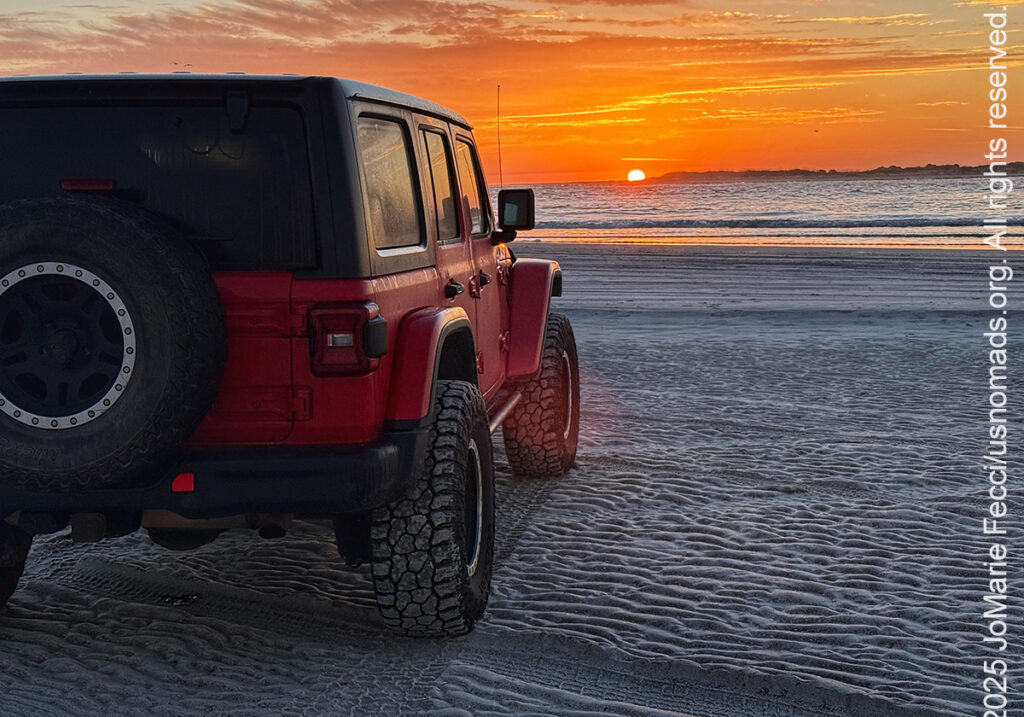
21 December 2025: Got out to Vilano Beach before first light and took some time to just walk along the waters edge as the night ceded to a crisp dawn on this Winter Solstice day. Watched the sun rise and the morning’s activity begin, and then went into the Old Town of St. Augustine for a little walk around the Castillo San Marcos and the waterfront, grabbing an early breakfast at the Casablanca Inn. Then it was time to turn inland and head out to the Ocala National Forest where I set up Christmas Camp under the Spanish Moss at the Hopkins Prairie campground. The weather was nice and though the campground was full, it was peaceful and it felt good to be back here. Before sunset I heard the familiar sandhill cranes as they took off for the night, and I got my fire going under the stars …
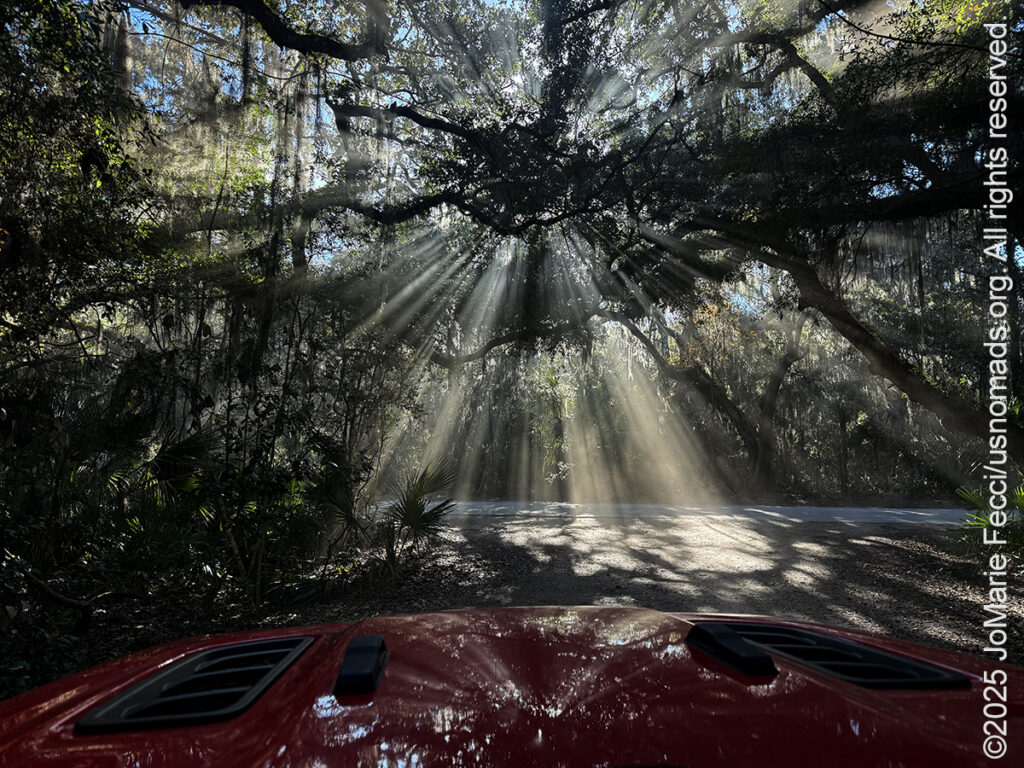
20 December 2025: Busy day today chasing some history as I made my way down through Florida’s Sea Islands towards St. Augustine from Amelia Island to Big Talbot Island to Little Talbot Island to Fort St. George Island then down to Vilano Beach. As I broke camp at Fort Clinch and headed out of the park, the suns rays reached through the live oaks like the fingers of God, and I did indeed feel blessed to be here at this moment. I turned south following the Atlantic coast to a part of the Island known as American Beach which has an interesting history and is part of the Timucuan Ecological and Historic Preserve, a somewhat unique unit of the National Park Service that brings together several scattered sites on these Islands. From American Beach I continued on the coastal route over the causeway bridge onto Big Talbot Island where I paused for a short hike in the dramatic landscape of Boneyard Beach. After a longer walk than I had planned, I got back on the road to my next stop in the Timucuan Preserve, on Fort St. George Island, where there is a nice dirt loop called the Saturiwa Trail, that connects a few different historical sites within a protected ecosystem space. I wanted to check out a remarkably well preserved series of tabby slave cabins at the Kingsley Plantation site. By the time I was done there, I had no more time to stop if I wanted to be at Vilano Beach in time for sunset, so I bee-lined down the A1A Coastal Highway, and arrived with enough time to grab a late-lunch/early dinner at Aunt Kate’s before heading out to the 4×4 Beach where I was just in time to watch as the sun set magnificently against the backdrop of St. Augustine with the silohuettes of the masts and sails of the sunset cruise boats against the orb of the sun. I took my shoes off as I walked along the beach and the sand felt good. As the sky turned gold and then orange and eventually dark, I left the beach and headed into St. Augustine proper where I was staying for the night. The city was crowded with tourists enjoying the “nights of lights” in the old town, but I went to bed relatively early as I was a bit tired after such a long day …
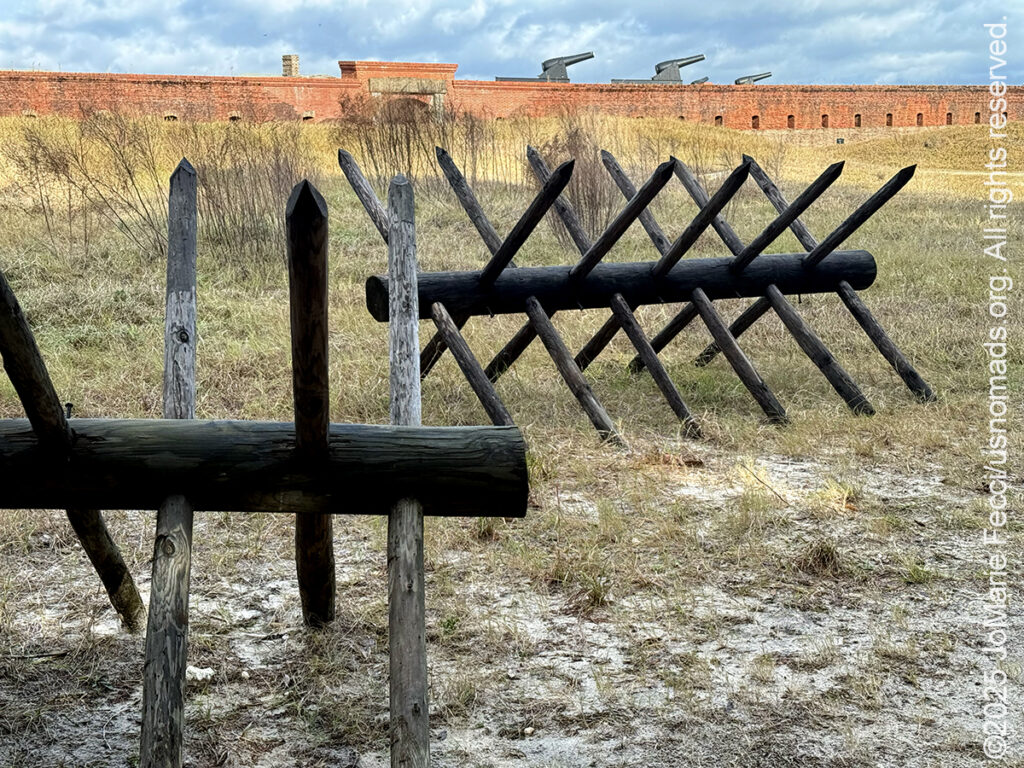
19 December 2025: The sun came out this morning and I caught the sunrise over the Atlantic Ocean before making my way down the beach to the old Fort for which Fort Clinch State Park is named. The morning light transformed the fort walls into a vibrant place that looked alive in contrast to the grey dreary look of yesterday afternoon. I decided to pay the entry fee to go inside and see if there was anything interesting within. It turned out to have a similar feel to an old caravanserai on the interior with stone walls arches and little bits of light trickling in from above. I also found the old cannons interesting because at their base was a giant “compass” with the headings etched in, so that they could move it to fire using target azimuths and it is the first time I am seeing this on any old artillery cannons. Later in the morning I went to the Eagan’s Creek overlook to see the Fernandina Beach lighthouse, and then continued on into town for much of the afternoon, before coming back to camp in the evening to enjoy a relaxed campfire under the Spanish moss draped oaks which took on an otherwordly atmosphere thanks to the multicolored Christmas lights that a lot of the other campers had put up around their RVs. It was warm and dry tonight and felt good to just be here relaxing by the fire …
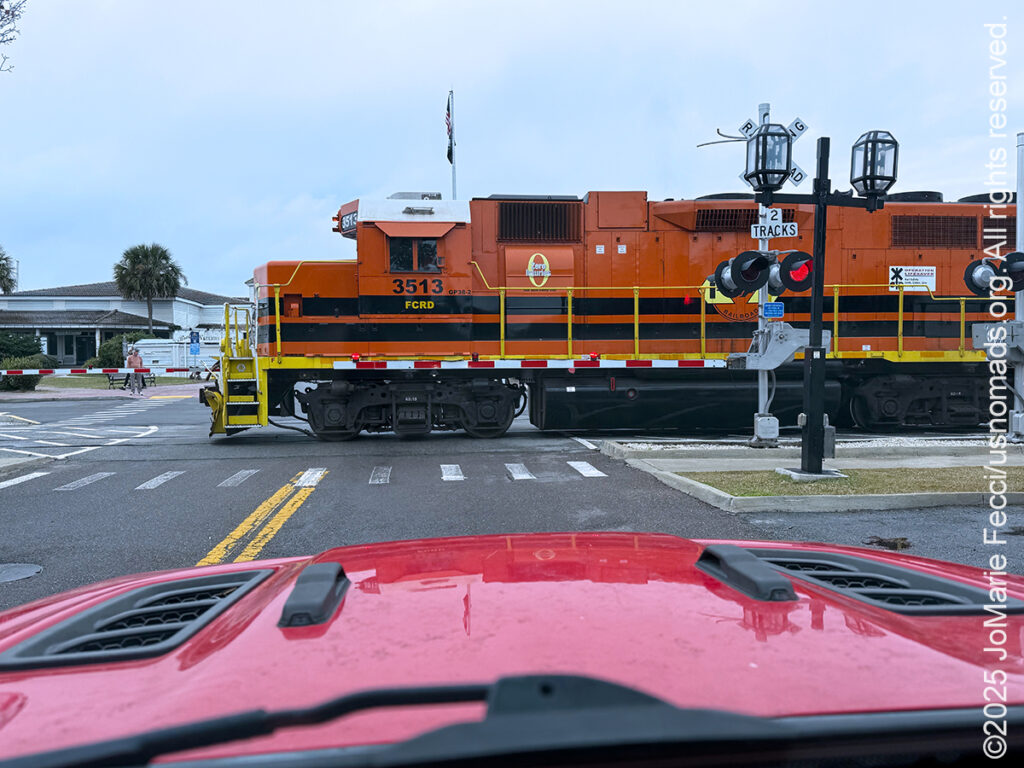
18 December 2025: It was overcast and drizzling as I left Fargo GA en route to Fernandina Beach FL. The rain continued pretty much the whole way, easing up a little bit in the afternoon. I was able to get my tent set up at Ft. Clinch State Park during one of the “pauses”, though it was still “misting.” I went for a walk to try to see the beach and the fort, but the mist and fog kind of “hid” everything and it had a sort of sad dreary look to it. Then on the way back from my walk, I encountered a little deer browsing in the brush and spent some time observing it before getting back in the Jeep and heading into the old historic town of Fernandina Beach where I planned to check out the Palace Saloon, which claims to be the oldest bar in the state. Visiting the town was a good way of staying warm and dry, and from the Palace I headed to the Salty Pelican for dinner. By the time I’d finished eating, the rain had mostly stopped, and I returned to camp to settle in for the night…
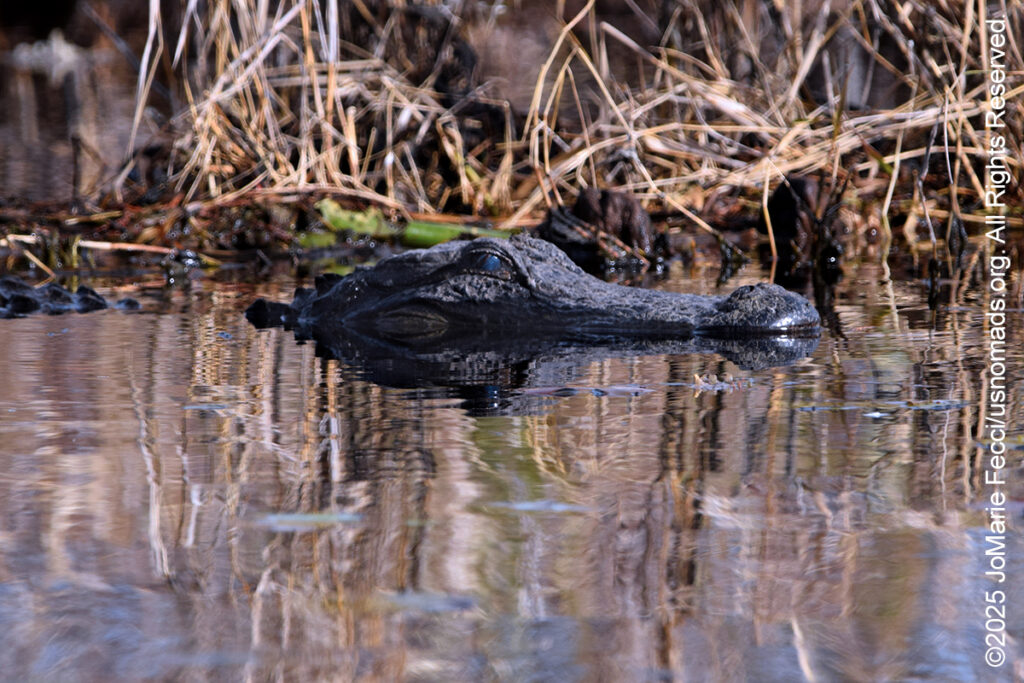
17 December 2025: Up early to catch the sunrise, which came up under the clouds in a striking transformation of the tree line, making it look like there was a blazing fire in the distance. At the Suwanee Sill I was really lucky to see a mother wild pig with her little ones, but it was still too cold for the gators. I had an appointment with a park ranger who took me out on the swamp in the morning, and it was calm. The sun came out and began to warm things up a little and as we returned towards the launch point we started to see the gators coming out. Afterwards, back at the Sill one of the big guys was sunning himself on the bank. In the afternoon I took a short hike along the “Trembling Earth trail” at the park before calling it a day. It turned out to be a good wildlife day afterall…
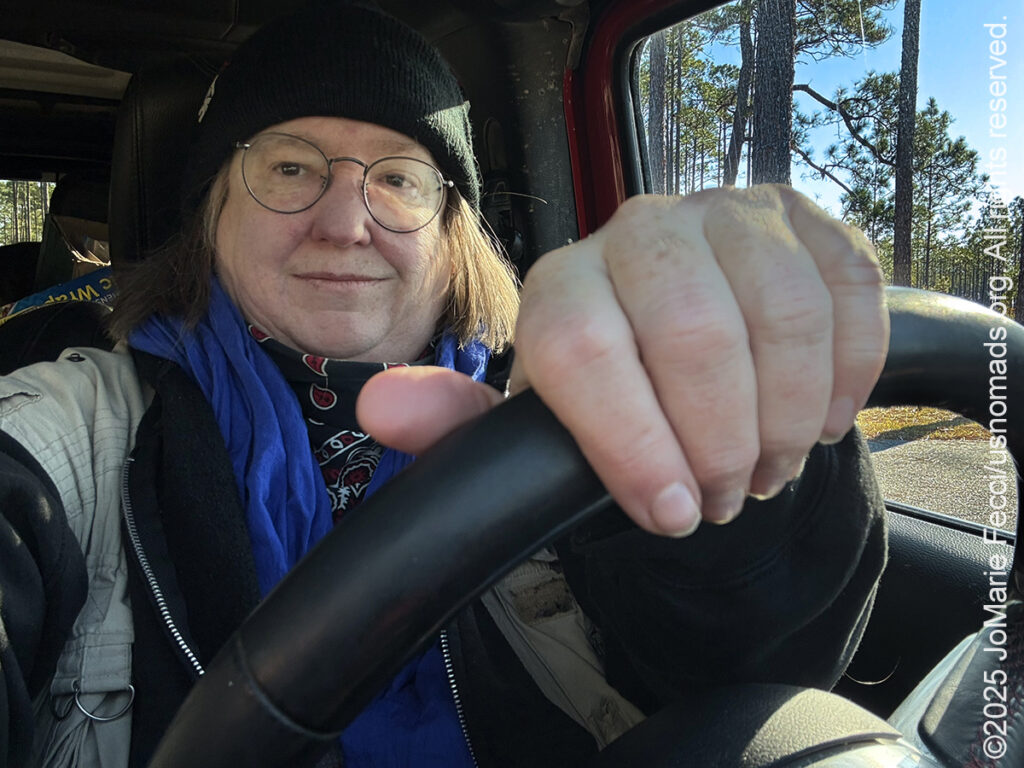
16 December 2025: Went back to the swamp early in the morning to do the Swamp Island Drive at the Okefenokee National Wildlife Refuge. I was hoping to follow up on some leads about the wildlife I picked up last night, but it was still just way too cold for the gators to be out, and I only saw a few birds and hooded merganser ducks and went for a walk on the observation boardwalk trail. Then it was time to go to the “otherside” of the swamp, administered as the Stephen C. Foster State Park. My first stop was the Suwanee Sill to look for gators, as the sun was out and it was warming up slightly. I was shocked by how low the water level was in the Sill. The “river” had dried up, and was just a thin ribbon at the bottom of its path. The trees roots that are usually submerged were exposed and I didn’t see much wildlife — just one lonely gator up on the bank. On my way to the Suwanee EcoLodge I decided to stop at a small park that surrounds the Stephen C. Foster monument at the beginning of the Suwanee River, and check that out…
THIS MONTH:
December is Holiday Roadtrip time, and this year we are heading back to a few favorite locations in the southeast as well as exploring a couple of new ones…
COMING UP SOON:
We will be taking part in an international overland expedition from the Sichuan Basin to the Tibetan Plateau in April, where we will be tracking snow leopards and working with local nomadic herders in cooperation with wildlife conservation efforts that aim to reduce human-wildlife conflict in one of the most remote areas of China…

USnomads.org is very proud to be presenting the fifth edition of the Nomad Rally in 2026. This is a unique kind of rally experience — a ten week event that participants can do from anywhere within the continental U.S.A. Competitors design their own routes as part of the rally, then drive it in a points-based online competition that includes optional activity tasks, quests and weekly challenges. The 2026 rally will run from 8 June – 17 August and is open to any driver within the United States who has an off-road capable vehicle — stock or modified. Registration for 2026 is currently open. For more information see the Rally website …
ABOUT KINGSLEY SLAVE CABINS
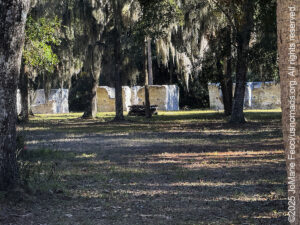
The site of the Kingsley Plantation on Fort George Island, near Jacksonville, FL, is part of the Timucuan Ecological & Historic Preserve and it contains well-preserved ruins of 25 tabby-constructed slave cabins built around 1820. The cabins are arranged in a unique, semi-circular pattern, reflecting West African design influences rather than standard southern plantation slave quarters. This unusual arrangement is a telling example of the unique circumstances of the Sea Islands, where African cultural traditions were more able to be preserved than in the rest of the south. The plantation was built by Zephaniah Kingsley, who was actively engaged with the Atlantic slave trade in Spanish Florida. In 1806, he traveled to Cuba and purchased three female slaves, one of whom was Anta Majigeen Ndiaye of Senegal. Zephaniah married Anta, who became Anna Madgigine Jai Kingsley in Florida, and they had a family together. The Kingsleys moved to Fort George Island in 1814 and built the plantation which originally occupied the entirety of the Island. While Zephaniah continued to travel and conduct business in the buying and selling slaves, Anna managed the large cotton plantation. She was an anomaly in the region–a former slave who owned property and managed a large plantation. It is said that the orientation and construction of the slave cabins was influenced by Anna’s memories of the village complexes that she was familiar with in West Africa…
ABOUT AMERICAN BEACH
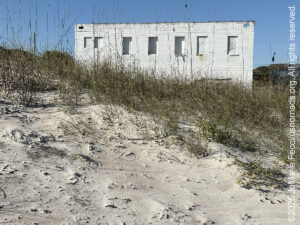
American Beach, located on the south end of Amelia Island, FL, is a historically significant coastal community founded by A.L. Lewis in 1935 specifically for African Americans during segregation when they were denied access to many public amenities such as public pools and beaches. Lewis, Florida’s first black millionaire and president of the Afro-American Life Insurance Company, founded the resort community as “a place for recreation and relaxation without humiliation.” Throughout the 1930s, 1940s, and 1950s, summers at American Beach were busy with families, churches, and children and the beach resort included hotels, restaurants, and nightclubs as well as homes and other businesses. It was a destination for numerous celebrities including folklorist Zora Neale Hurston, musicians like Cab Calloway, Ray Charles and Billy Eckstein, baseball great Hank Aaron, the boxer Joe Louis and many more. After the Civil Rights Act desegregated the beaches of Florida in 1964, American Beach as a Black resort became less of a necessity and many African-Americans turned to locations closer to home.In 1977, A.L. Lewis’s granddaughter MaVynee Betsch, known locally as the Beach Lady, returned to American Beach to fight for its preservation as a monument to black Americans’ determination to overcome the obstacles of the Jim Crow era. As of January 28, 2002, American Beach is listed as a historic site by the National Register of Historic Places. In 2003, Amelia Island Plantation donated the 8.5-acre pristine sand dune called NaNa to the National Park Service. At 60 feet high, NaNa is the largest sand dune in Florida, and was a central part of the American Beach community. Today the quiet little community of American Beach remains in transition. Modest vacation homes dating from the 1930s share space with vacant lots, abandoned buildings, and newer, more elegant structures. The American Beach sites are now managed by NPS as part of the Timucuan Ecological and Historic Preserve….
ABOUT OKEFENOKEE SWAMP
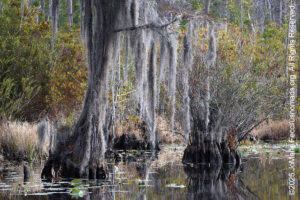
The Okefenokee National Wildlife Refugee conserves the unique qualities of the swamp, protecting and enhancing the wildlife and its habitat to ensure the integrity of the ecological system. The Refuge also sees part of its mission as embracing the grandeur, mystery, and cultural heritage of the area. Native Americans inhabited the swamp for centuries and coined the term “Okefenokee” which means “land that trembles when you walk on it.” The swamp is thought to be 6,000-8,000 years old. It is contained in a saucer-shaped depression that drains toward the south and southwest. Drainage from the swamp forms the headwaters for the St. Marys River and the Suwannee River. Habitats provide for threatened and endangered species, such as red-cockaded woodpecker, wood storks, indigo snakes, and a wide variety of other wildlife species. It is world renowned for its amphibian populations that are bio-indicators of global health. More than 600 plant species have been identified on refuge lands. The Swamp survived an attempt at draining in the late 1800’s and was logged extensively in the early 1900’s before becoming a refuge in 1937 by declaration of Franklin D. Roosevelt. The refuge has 353,981 acres of National Wilderness Area within its boundaries and is a Wetland of International Importance (RAMSAR Convention – 1971) because it is one of the world’s largest intact freshwater ecosystems…
Nesconset | Paris | Belgrade | Berlin | Folkston | Fargo | Fernandina Beach | St. Augustine | Fort McCoy | Tampa | St. Marys
MORE NOTES FROM THE ROAD:
1-15 December – Holiday Roadtrip
November – New York
22-31 October – Paris
16-21 October – Paris
1-15 October – Paris
22-30 September – Vermont
13-21 September – Vermont
1-12 September – New York
16-31 August – New York
1-15 August – New York
July – New York
June – New York
May – New York
18-30 April – New York
8-17 April – Eastbound
1-7 April – Eastbound
22-31 March – California
17-21 March – AZ to CA
8-16 March – Arizona
1-7 March – Glamis
22-28 February – Roadtrip SW
15-21 February – Roadtrip SW
1-14 February – New York
January – Paris
23-31 December – Holiday Roadtrip
16-22 December – Holiday Roadtrip
Archive
ROADTRIP

An epic journey crisscrossing the USA from east to west and back again, exploring some of the beautiful wild spaces that make up our “public lands.” The roadtrip covered almost 15,000 miles, much of it off-grid and off-pavement, focusing on the deserts of the American southwest. Some locations were truly “iconic” while others were little known, and the segments of independent exploration where punctuated with some fun events across the region… [read]
SPECIAL REPORT
All about exploring ghost towns and abandoned places in the USA and beyond, with tips, and information on the many different types of sites to be found across the globe, including detailed guides for eight specific sites… [read]

