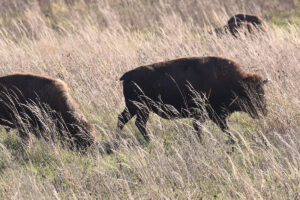
Day 5: IA to NE — Where the Prairie Meets the Sky
The Great Plains don’t announce their arrival. There is no mountain pass, no dramatic shift in elevation, no billboard declaring that you’ve crossed into a different kind of country…

I’ve driven this road before. In fact, the Jeep and I have crossed the country more times than I can count. Usually, it’s a well-worn back-and-forth rhythm between New York and the Southwest — a long, winding trek once or twice a year to explore, take photos, and get some dirt under the tires. I’ve taken southern routes, northern routes, and plenty of indirect blue routes that made zero sense on paper but looked way too interesting on a map to pass up.
 I’ve never been big on simply driving from Point A to Point B. If I’m going to spend days behind the wheel, I want some adventure along the way. So, on the surface, packing up the rig for another cross-country run isn’t unusual. The Jeep is ready, the camera gear is packed, and the route is set.
But this trip has one major twist that changes everything: This time, it’s a one-way drive.
I’m relocating to Henderson, Nevada, and setting up a new home base in the heart of the Southwest. That means when the Jeep rolls off Long Island tomorrow morning, it’s not heading west for a few months of events and trail fun — it’s heading west to stay.
That simple detail — knowing I won’t be making the return roadtrip back to New York — completely changes the lens I’ll be looking through for the next two weeks.
Seeing familiar highways and favorite stops “for the last time” (or at least for the last time that I pass through in quite this way, lol) transforms the journey into a different kind of exploration. It’s no longer about “scouting” new places but rather documenting the essence of a route.
Follow along with this series as we cover some serious ground — crossing Appalachian ridges, sweeping over the Great Plains, winding through high-desert badlands, and climbing over Great Basin mountain ranges before descending into the Mojave. There will be old haunts, brand-new discoveries, plenty of dirt roads and almost certainly a few unexpected detours when a side trail looks better than the highway.
Two weeks, thousands of miles, one Jeep, and a brand-new horizon ahead. Let’s roll.
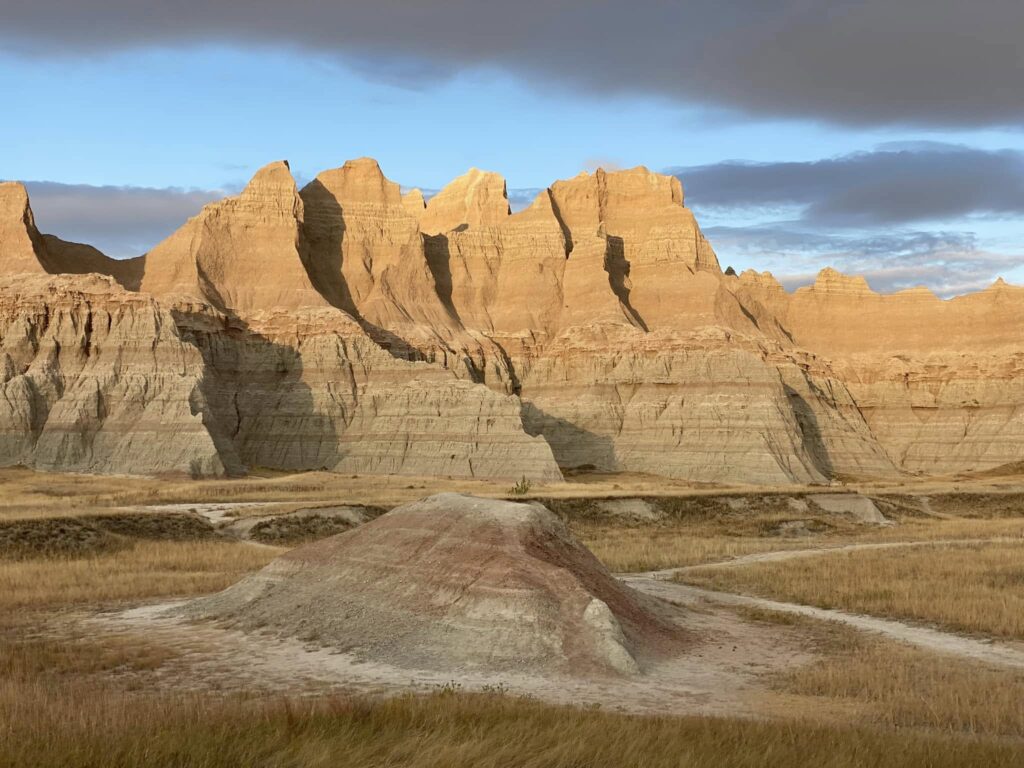
 There are two ways I have always looked at a landscape. One is to see what lasts. The mountains, the cliffs, the ancient rock layers, the rivers that have been cutting their way through the earth for thousands or millions of years. These are the things that seem almost permanent, existing on a scale of time that makes a human lifetime feel very small.
The other is to look for what disappears. A storm moving across the desert. A cloud shadow sliding over a canyon wall. Tire tracks crossing a dry lakebed. The last light of sunset catching the edge of a mesa. Footprints in the sand that will be gone with the next wind.
I think about this distinction often in photography. I call it the eternal versus the ephemeral.
The desert is perhaps the clearest place to see both at once. The rocks may have been here for hundreds of millions of years, but the light that makes them extraordinary might last for only a few minutes. A mountain can remain unchanged while the landscape around it is transformed by a passing storm. A dry wash can look ancient and immutable until a flash flood redraws it in a single afternoon.
There is something humbling about photographing that intersection. To stand in a landscape that has existed for millions of years, knowing that what you are seeing in that particular moment may never look exactly the same again, is a reminder of how strange our place in time really is.
We spend our lives moving through landscapes that existed long before us and will remain long after we are gone. We leave footprints, tire tracks, photographs, roads, buildings, memories. Some will disappear almost immediately. Others may linger for generations. And yet, from the perspective of the landscape itself, even our longest marks are temporary.
 Perhaps that is part of what has always drawn me back to the desert. There is always another canyon, another trail, another forgotten road waiting somewhere beyond the horizon. But there is also the knowledge that nothing stays exactly as we find it—not the landscape, not the light, and certainly not ourselves.
And this journey carries that idea a little closer to home. For years, I have explored the desert as a visitor. I have come and gone, returned to places I loved, searched for places I had never seen, and eventually driven back east again. This time, I am not simply traveling into the desert. I am moving to it. That changes something.
The road ahead will cross landscapes shaped by oceans that disappeared hundreds of millions of years ago, glaciers that vanished thousands of years ago, trails carved by migrating animals, roads built by emigrants, and towns that existed for a generation before disappearing almost completely.
Along the way, there will be plenty of reminders of how temporary we are. And perhaps that is the real reason I keep coming back to these landscapes. The desert does not pretend that things last forever. It simply places the temporary and the permanent side by side and lets you decide which one you are looking at.
The Great Plains don’t announce their arrival. There is no mountain pass, no dramatic shift in elevation, no billboard declaring that you’ve crossed into a different kind of country…
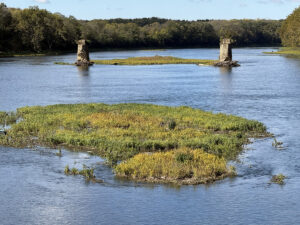
The river outlasted the bridge. Along the Kankakee River in Illinois, old stone or concrete pylons stood in the water, the structure they once supported long gone…

Long before sunrise, the quiet hum of the Jeep’s engine cut through the pre-dawn darkness of Toledo…
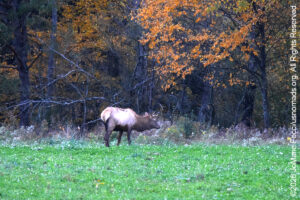
Dawn changes the character of a place. In Benezette, the valley is quiet again…