For generations, the West has carried the promise of something different. Not necessarily something better — at least not for everyone, and certainly not without a heavy cost — but something possible.
That possibility has worn many faces. To someone living in a crowded city, the West meant space: room to breathe, spread out, and build a home where the horizon wasn’t entirely swallowed by concrete. For someone facing poverty, it represented the chance to start over somewhere not yet defined by circumstance. To the restless, it was adventure. To the ambitious, a blank slate on which to risk building something new. Perhaps for some, it was simply the hope of becoming someone different from the person they had been back home.
The reasons were never the same, but the underlying attraction was remarkably consistent. Heading west offered the opportunity to leave behind the limitations of the life they knew and create something that didn’t yet exist.
That idea remains immensely powerful, stretching far beyond the history that produced it. The West became a canvas onto which people projected their deepest hopes — a real landscape charged with imagined meaning, which is precisely why its pull endures. We still do it today, catching sight of a mountain range rising beyond the highway or a dirt road disappearing into the desert, instantly wondering what lies just out of view.
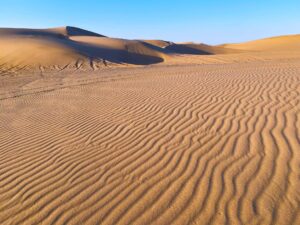
Possibility has a geography, and the West has always seemed uniquely suited to creating it. Part of that comes from the sheer physical scale of the land. Immense distances separate towns and mountain ranges. The horizon stretches farther than we are accustomed to seeing. After spending time in dense, noisy places, that kind of space feels almost tangible. You notice the profound absence of clutter: fewer buildings, fewer cars, and fewer constant reminders of where you are supposed to be or what you are supposed to be doing. There is room to think.
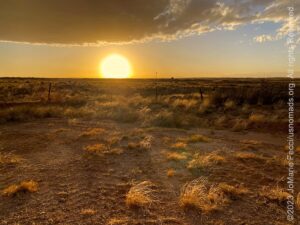
Then there is the light. Blue skies and sunlight sound deceptively simple until you realize how profoundly they can alter the way a place feels — and how you feel within it. A bright morning makes a day feel electric with potential before anything has even happened. The desert is particularly good at this. With so little between you and the sky, the atmosphere becomes part of the landscape itself. Clouds turn into events, sunrise and sunset serve as architecture, shadows sweep across the mountains, and the land shifts color by the hour.
The light doesn’t just illuminate the landscape. It changes the mood of being there.
Perhaps that is part of why the West has inspired such enduring imagination. The landscape seems to invite you to look outward and dream of going somewhere. That image is woven deeply into our cultural mythology: the solitary figure moving toward the setting sun, leaving the past behind for whatever waits next. Though used often enough to verge on cliché, the metaphor survives because it touches on something fundamentally true: the quiet thrill of turning toward a horizon without knowing exactly what is waiting there. There is freedom in that uncertainty. There is also possibility.
That may be the truest promise of the West: not that it will solve everything or make life effortlessly easy, but that there remains room to imagine something different, to try, to wander, and to begin again. Maybe that is why people keep looking toward the horizon. Not because the answer is waiting out there, but because the possibility is enough to make you want to go see.
Riding off into the sunset means choosing a direction and trusting that whatever comes next is worth discovering.